RenderingPerformance8 min read
Mermaid diagrams in the terminal
tuios mermaid draws Mermaid diagrams right in your terminal, as a picture or as text. It runs on sketch, a pure Go port of pele by kepano. Here is how the port stays faithful to pele, how the text drawings work, and what a perf pass against ondine bought.
GGGaurav Gosain
Agents love Mermaid. Every plan, every design note, every README an agent writes for me seems to have a flowchart in it. And in a terminal I could never actually see one. I'd read the source, squint, and imagine the boxes.
Then kepano released
pele, a Mermaid renderer from the
Obsidian folks that draws diagrams without a browser, fast, with output that's
safe to put in a page. I read the code and thought, this would port to Go
really well. So I ported it. It's called tuios.dev/sketch, and tuios mermaid uses it:
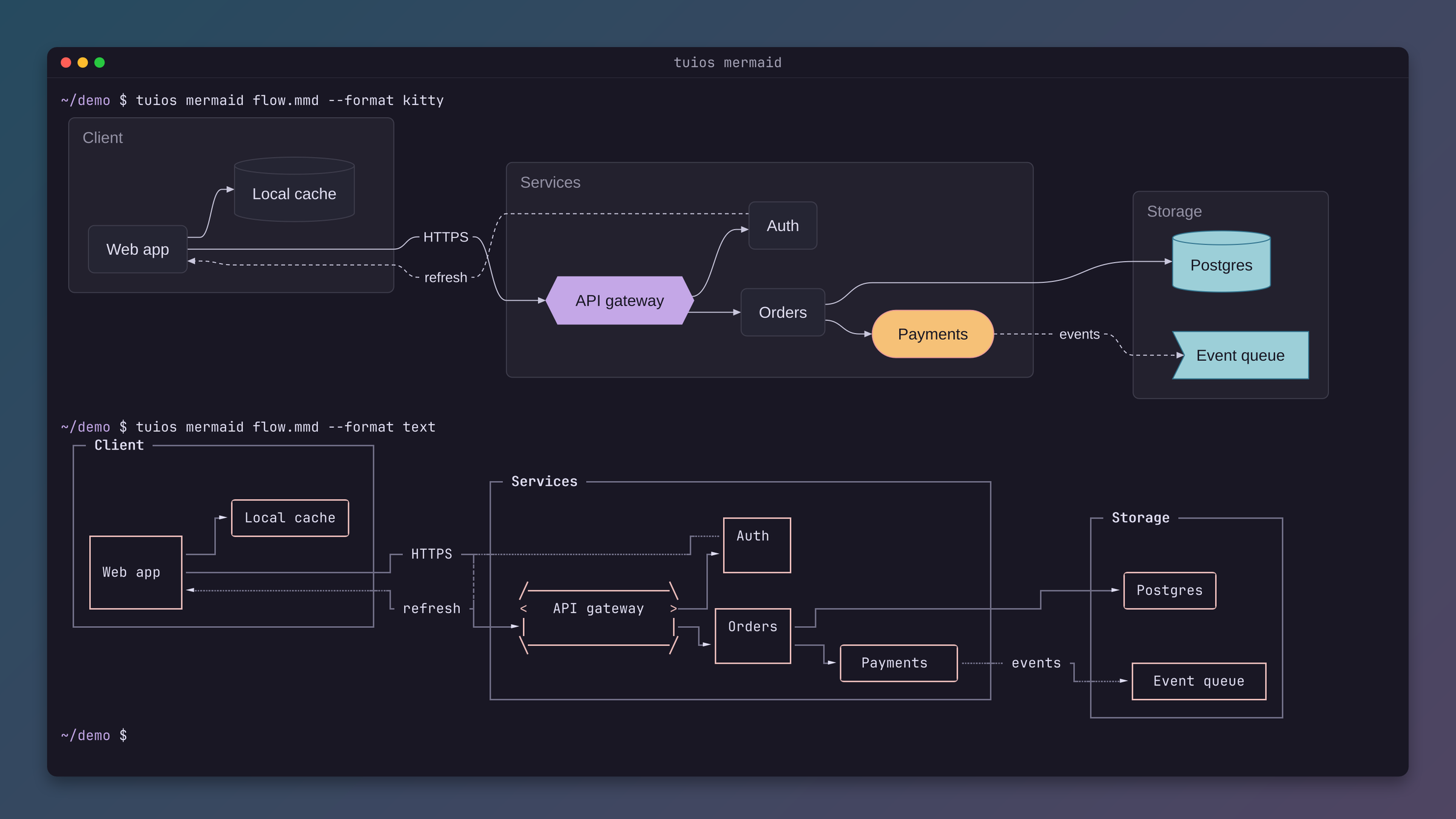
Where the terminal shows images, you get a real picture in your tuios theme. Everywhere else, over SSH, in a plain terminal, in a log, you get the same diagram drawn with box-drawing characters, from the same layout. All the credit for the design, the layout engine, the shapes and the test corpus goes to pele and kepano. I just moved it to another language.
Try it right here
sketch also compiles to WebAssembly, so the playground below is the same Go code running in a worker in this tab. Type in the editor and watch the diagram move to its new layout. Nothing goes to a server.
Type Mermaid here.
The engine is a download of about 2.7 MB, once. In a quick Node run it drew a flowchart in about 30 ms cold. The full-page playground has more room and a share link.
A port, file by file
I wanted the port to be boring to keep up to date. Each Go file is the port of one pele file and keeps its names and comments, so when pele changes upstream, I can find the matching Go and change it the same way. A script lists the pele commits after the pin. sketch follows pele v1.7.0 now, which taught it to wrap Chinese and Japanese labels between characters.
The test that keeps me honest is pele's own documentation corpus: 522 Mermaid
sources, each with the SVG pele drew. sketch has to produce the identical SVG.
On main today all 522 match, across all 33 of pele's diagram types, on plain
amd64 and at GOAMD64=v3. Changing one layout constant fails 14 of the 114
flowcharts, so the test notices small things.
Matching pele exactly meant matching JavaScript in a few odd places. pele runs
on V8, so sketch carries its own copies of JavaScript's number formatting,
Math.round, V8's sin and cos, and Date.parse. The XY chart picks its
tick steps with Math.log10, and Go's math.Log10 differs from V8 in the last
bit on 258,678 of 1,086,347 inputs I tried. So sketch has log10 ported from
fdlibm, as V8 does, and that one matches on all of them.
Then arm64 showed up. Go may fuse x*y+z into one FMA instruction, and on
arm64 it does, which rounds once instead of twice. A CI job now runs the
goldens on an arm64 runner and at GOAMD64=v3, and the products that matter
are wrapped in float64() so the compiler leaves them alone.
Diagrams as text
The text drawing was the part I was most excited about, honestly. A picture needs a terminal that shows images. Text works everywhere, and an agent can read it too.
It started with flowcharts and sequence diagrams.
#951 added state, class, ER,
pie, mindmap and gantt diagrams, and
#948 added XY charts,
timelines and quadrant charts, and
#949 added user journeys,
kanban boards, git graphs and sankey diagrams. The other 18 types, from block
and C4 diagrams to railroad and use case diagrams, came with their own text
drawings in #954,
#955,
#957 and
#958, so every type has one
now. Here are four of them, drawn by tuios mermaid -f text in tuios panes:
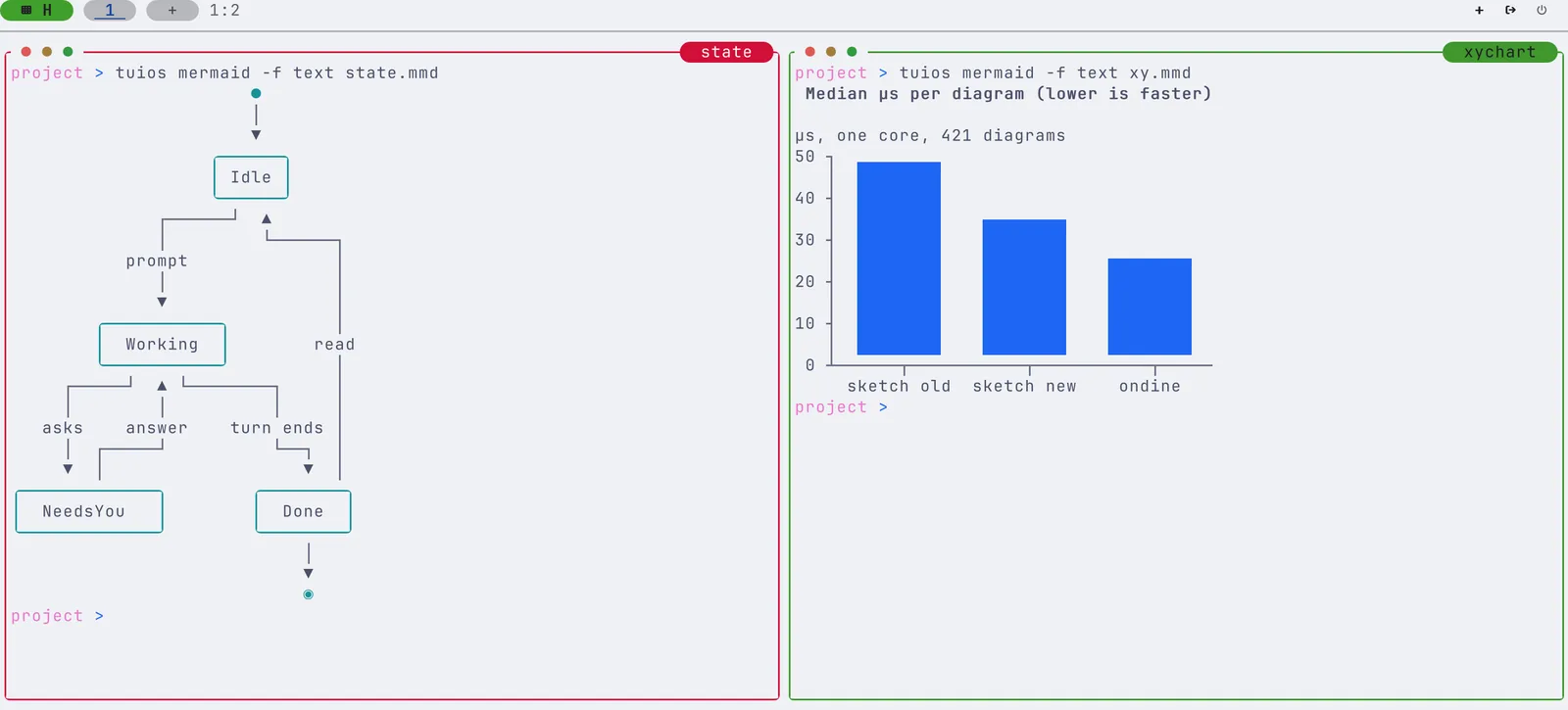
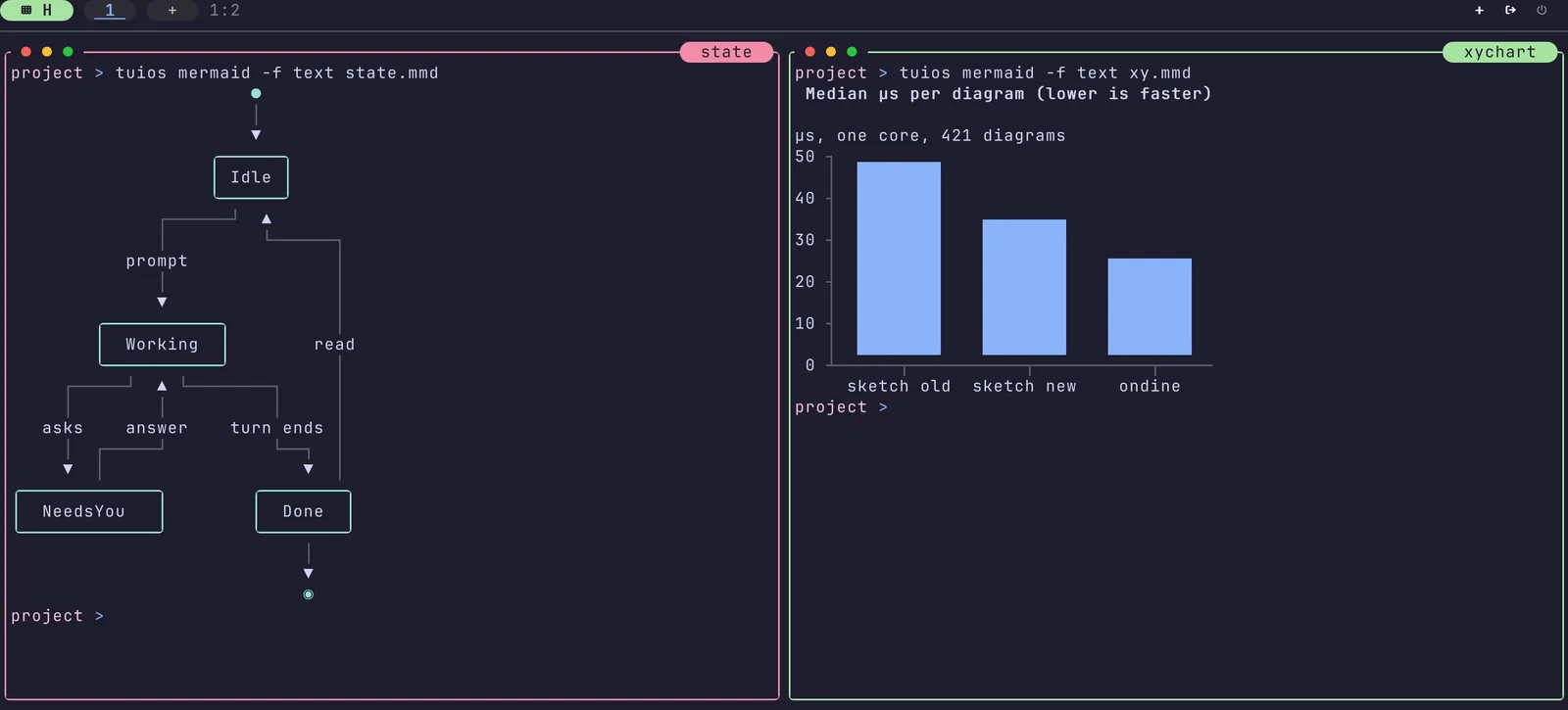
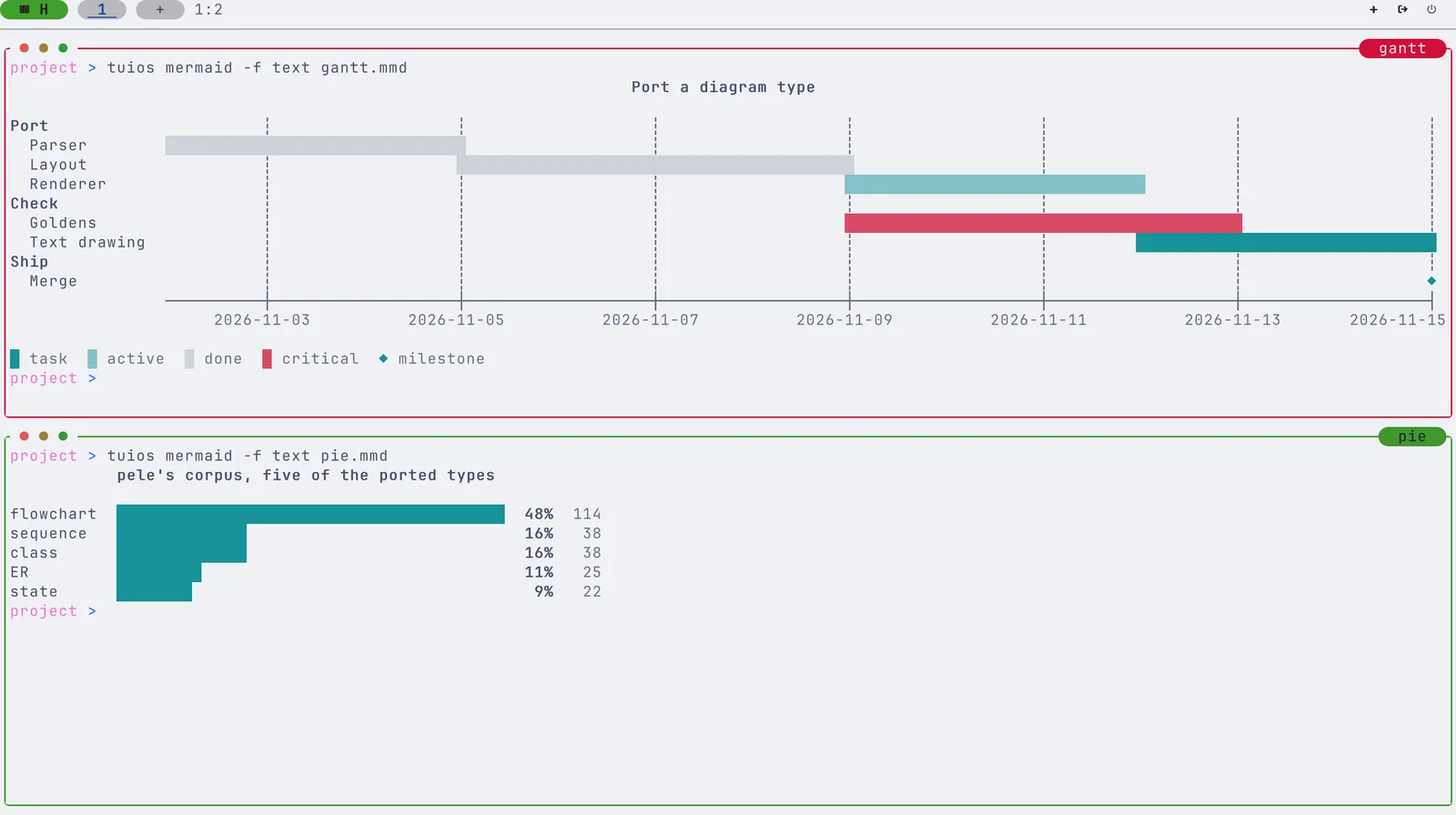
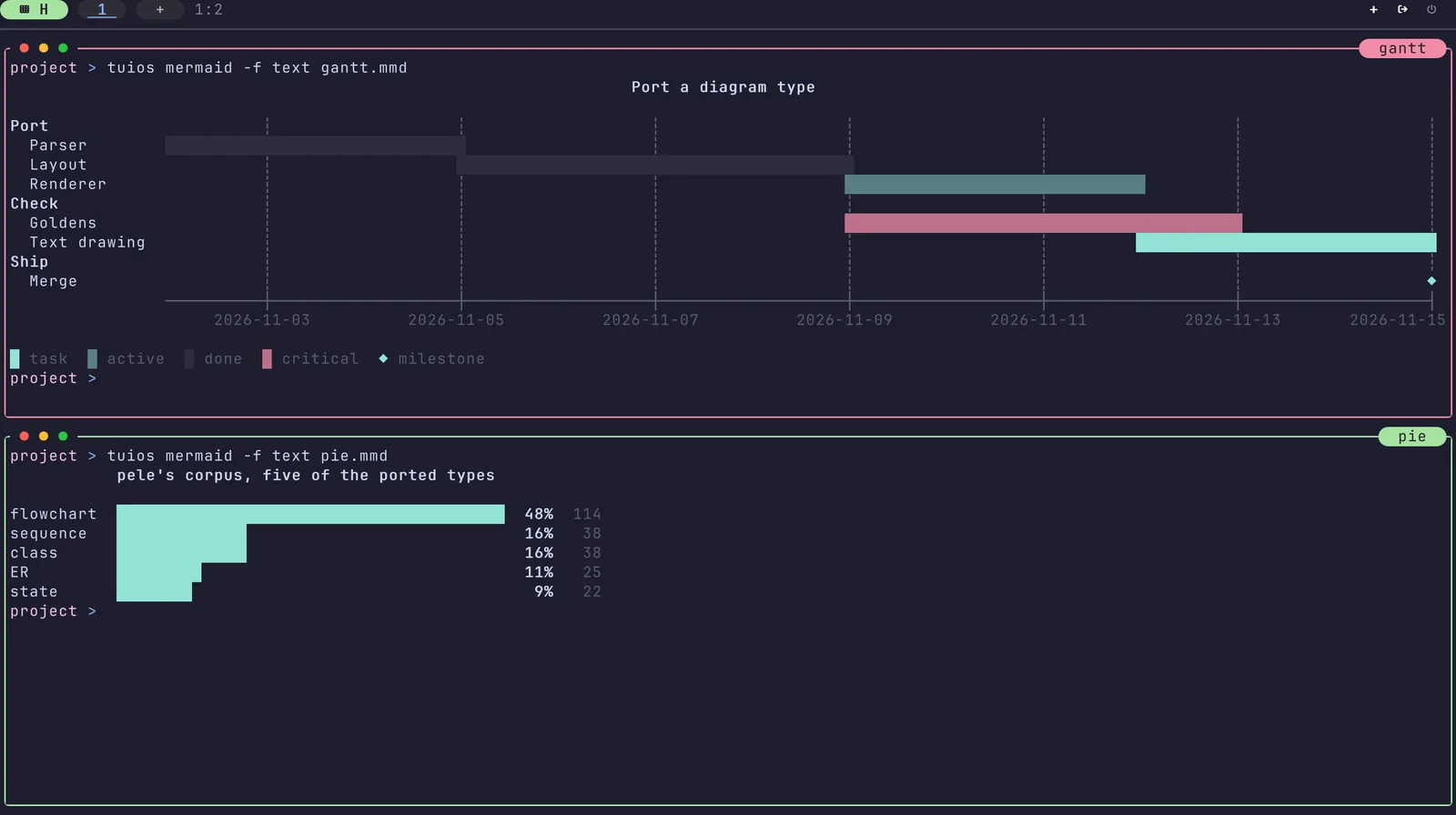
State, class and ER diagrams go through the same compound layout as flowcharts, with a small hook for box sizes, node shapes and end marks. A class relation gets real UML ends: △ for inheritance, ◆ for composition, ◇ for aggregation. The XY chart borrows from plot, so bars are eighth blocks and lines are braille. A text drawing costs 18 to 85 µs per corpus diagram at 120 columns, layout included.
Safe to show
A diagram's labels come from whoever wrote the file, and a terminal takes
escape sequences. During review, a node labelled A["#27;]2;pwned#7;"] set the window
title, since Mermaid turns #27; into an escape character. Every text drawing and every string tuios mermaid prints now
goes through a filter that turns C0 and C1 controls, DEL, bidi overrides and
invalid UTF-8 into U+FFFD.
The picture side had its own fun. style A stroke-width:1e20 wrapped an int
and cost about a minute of CPU per node. The rasterizer now sums its work
budget in float64 and holds strokes to four image diagonals, and that test went
from 56 s per case to under 10 ms. pele's own tests for inert output are
ported for each type, and every type is fuzzed.
The perf pass against ondine
The first version already beat pele, which runs on Node, on all 152 flowchart and sequence sources I timed: a median of 21.8 µs against 43.6 µs warm. A fresh process drawing one diagram took about 2 ms with sketch and about 60 ms with pele, since Node has to start first.
Then ondine came along, a Rust port of pele. I ran both on the same 421 diagrams, same machine, same settings, and ondine was about 1.9x faster warm and about 3x faster cold. That was a fun challenge :) #928 was the result, measured on one core over a 421-diagram corpus, median of 300 renders each:
| per diagram | sketch before (µs) | sketch after (µs) | ondine (µs) |
|---|---|---|---|
| median render, | 46.1 | 32.7 | 23 |
| one-shot CLI, median flowchart, | 2,120 | 1,120 | 720 |
The biggest single win was start-up. About 1.4 ms of every sketch start went
to package init, mostly some 100 package-level regexp.MustCompile calls. They
compile on first use now, and the hot ones (flowchart links, label markup,
class names) are hand-written matchers. Each matcher has a fuzz target that
compares it with the regexp it replaced. Init of sketch's packages went from
0.94 ms to 0.08 ms.
The rest was the usual: SVG written by appending to buffers instead of building strings, layout slices sized up front, and fewer allocations per render, 336 down to 234. A test now fails if a render goes over 260 allocations, so it can't creep back.
The output did not change at all. 842 of 842 SVGs from the corpus, with two different text measurers, came out the same as before, checked after every commit.
ondine is still faster than sketch on all three things I measured: warm, cold and memory. Warm, it is 1.28x faster per diagram. Cold, the gap is 0.4 ms now. It also uses 1.3x to 1.9x less memory in my runs: 1.3x to 1.6x for one diagram in a fresh process, and 1.9x for a process that renders the whole corpus. That's peak resident memory of each run, best of 5. On four cores the corpus sums are 20.3 ms for sketch and 19.3 ms for ondine. On one core the garbage collector is about 19% of sketch's render time, so that's where the next round would go.
Watching a file
tuios mermaid --watch notes.mmd fills the terminal with the diagram and
draws it again each time you save. The shapes slide and grow to their new
places over 260 ms, new parts fade in, and edges morph. --split shows the
source next to it. Between changes there is no timer and no frame: 0 CPU ticks
and 0 context switches in 5 seconds.
What it cost, and what is next
Mermaid with its fonts, themes and text drawings added about 2.2 MB to the tuios binary when it first landed, and the size ceiling went from 40 MB to 45 MB for it. The other 25 types added about 3.3 MB more, and the last three pushed tuios past 45 MB, so the ceiling is 50 MB for now. My plan is to move heavy optional parts like this into plugins, now that tuios has native plugins, and bring the ceiling back down.
sketch draws all 33 of pele's types on main today, each as a picture and as
text. Everything here goes out in v0.11.0. Until then, the
sketch page has the Go API, and
go get tuios.dev/sketch works today.
Thanks again to kepano for pele. It's a lovely piece of code to read.