Rendering5 min read
Colour emoji in a screenshot, from three font tables
tuios screenshot drew every emoji as a blank. A colour emoji font keeps its emoji as pictures, not outlines, in tables the Go font package does not read, and a flag or a family is one picture that only the font's own ligature table can find. shot reads sbix, CBDT and morx or GSUB now.
GGGaurav Gosain
tuios screenshot draws a pane with tuios's own renderer, the
shot library, so a capture looks the same on every
machine and needs no screen. Agents print emoji all the time: a check mark at
the end of a test run, a rocket in a deploy log. And in every screenshot, each
of them was blank.
Here is the same pane shot by tuios v0.12.1 and by main today:
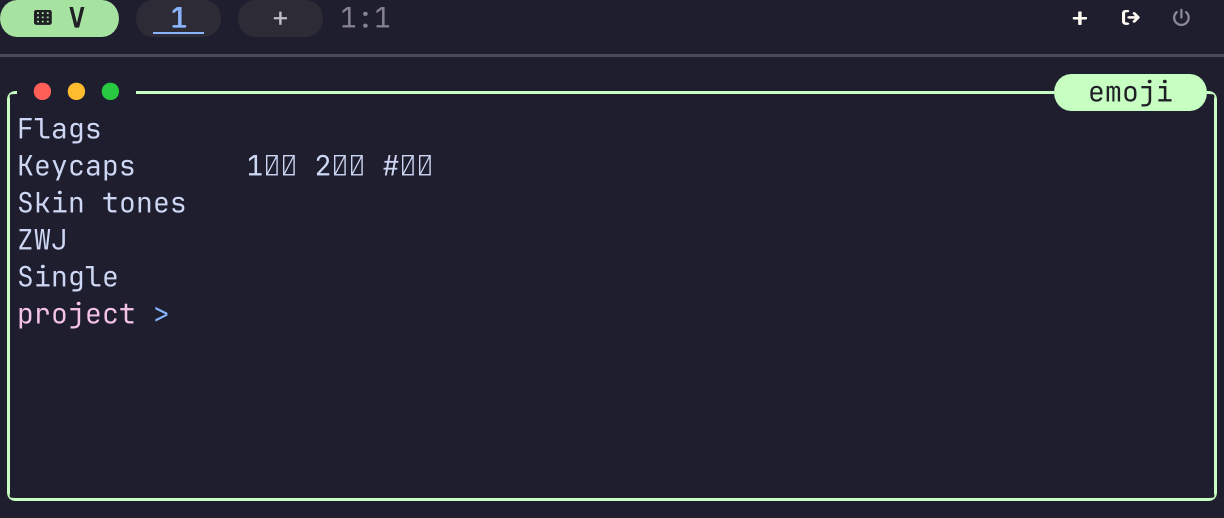
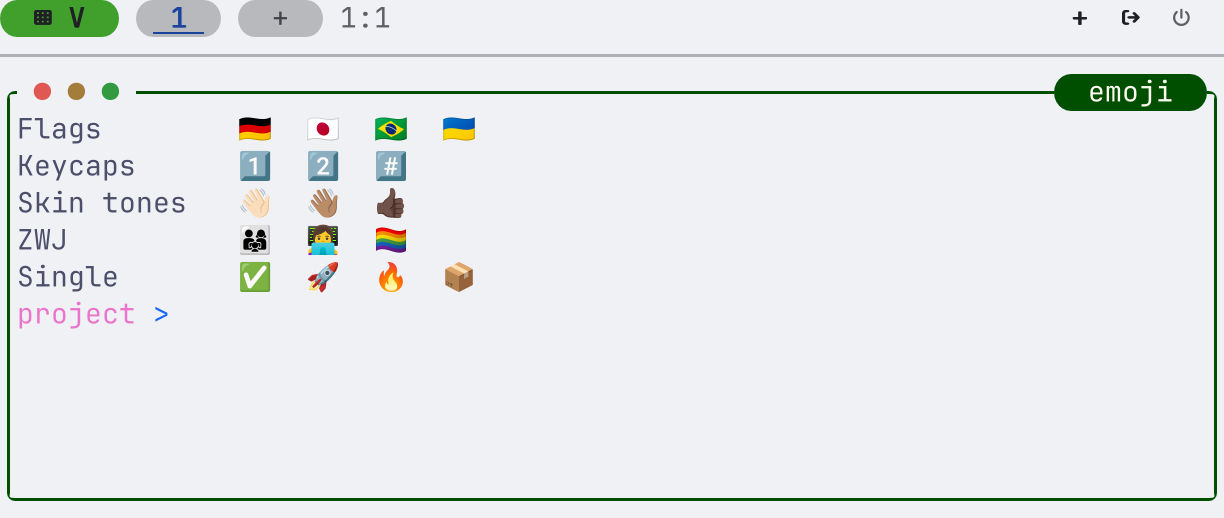
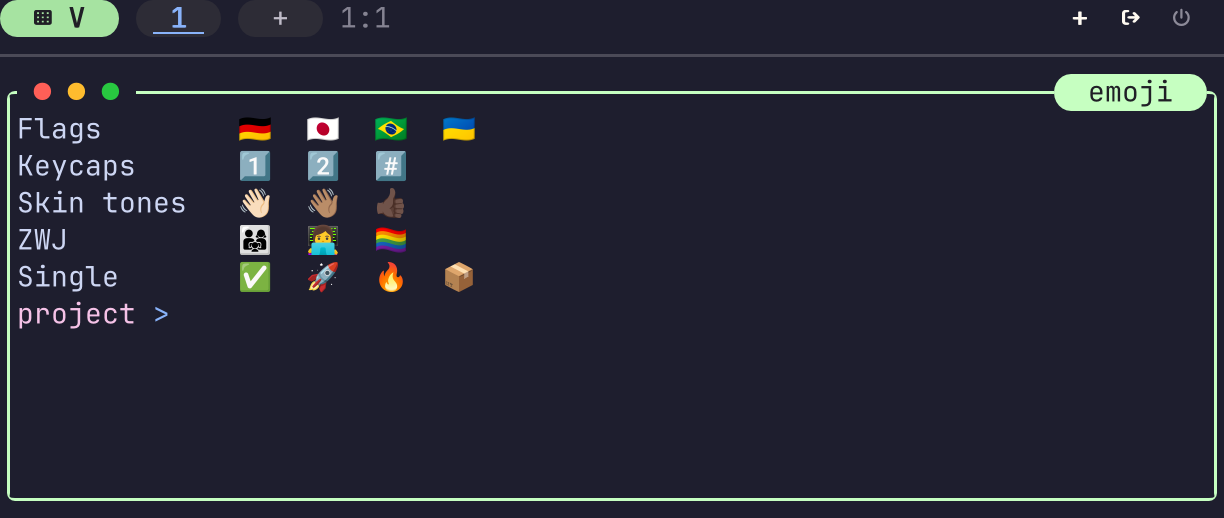
Two separate problems were behind the first picture. A single emoji had nothing to draw it, and a sequence such as a flag needs a glyph that no single code point names. The first fix uncovered the second.
An emoji is a picture, not an outline
shot drew text through the opentype face of golang.org/x/image. That face
draws glyph outlines, the curves a normal font is made of. A colour emoji font
has no outlines for its emoji. It keeps a small PNG of each one, at a few sizes,
in a table of its own:
| Table | Font | What it holds |
|---|---|---|
sbix | Apple Color Emoji, on macOS | A PNG per glyph, per size (a "strike") |
CBLC and CBDT | Noto Color Emoji, on most Linux systems | An index of strikes and glyph ranges, and the PNGs |
COLR and CPAL | Segoe UI Emoji, Twemoji | Layers of outlines, each in a palette colour |
So the glyph was in the font's character map, the face had nothing to draw for it, and it came out blank. Worse, the check that finds missing glyphs asked only the character map. It saw the emoji as covered and never tried another font.
x/image's font parser gives no access to tables it does not read itself. So
shot now reads the font's table directory, and those tables, on its own. Every
read is bounded by its table's size, and a table that does not add up makes the
face colourless, never a panic. For a glyph, it picks the strike that fits the
cell, decodes that one PNG, scales it into the cell keeping its shape, and
caches the result, so a screen full of one emoji decodes one picture.
The coverage check changed with it: a face has a glyph only when it can draw it, from an outline or a picture. A font with a glyph it cannot draw no longer stops the search for one that can.
A font of 190 MB
Apple Color Emoji is about 190 MB. tuios used to read every fallback font into
memory whole. shot's font type now takes an io.ReaderAt as well as bytes, and
the colour reader reads only the tables and the glyph records it needs. A
screenshot with three emoji reads a few hundred KB of that file.
tuios screenshot also asks fontconfig for an emoji face, after the text
fonts. Before, it did not ask, because shot could not have drawn what it found.
A flag is one glyph that the font has to find
With that, a single emoji drew in colour. A flag still drew as two letters, a family as its first person, and a thumbs up with a skin tone as the yellow hand.
A cell holds its whole grapheme cluster, so shot had all the code points. It drew the first one. A flag is two "regional indicator" letters, and there is no code point for the German flag. The font has a picture for it, and finds that picture with a ligature: a rule that says these glyphs in a row become that one glyph.
The two fonts keep their ligatures in different places:
- Noto Color Emoji uses
GSUB, the OpenType substitution table. A ligature there is a lookup in a list, under theccmp,ligaorrligfeatures. - Apple Color Emoji has no
GSUBat all. Its ligatures are inmorx, Apple's own table, as a state machine: it walks the glyphs, pushes some on a stack, and on certain transitions replaces what is on the stack with one glyph.
shot now runs that table over a cluster's glyphs and draws the glyph that comes
out. A variation selector the font does not list, such as U+FE0F, is dropped
first. A cluster with no ligature draws the first glyph the table leaves, never
a box.
A state machine read from a file is font input, and font input can be wrong or hostile. So it has bounds: at most 4 steps per glyph plus 16, a stack of 32, and every read inside its table. A table that breaks one is refused, and that face stops shaping. A fuzz target ran the shaper on random bytes for 27 million executions with no failure.
How well it works
I checked 780 emoji sequences against both fonts. Apple Color Emoji draws 362 of them as one colour glyph, and Noto Color Emoji 363, every country flag among them, with no table refused.
What it does not do yet:
- COLR layered glyphs, the third row of the table above. No font on the machines I test on uses them, and I did not want to ship a reader with no test behind it.
- sbix pictures stored as JPEG or TIFF. No Apple emoji uses them.
- A couple with two skin tones is two glyphs side by side in Apple's font, and draws its first.
The SVG and HTML formats were never affected. They keep emoji as text, and the viewer's own fonts draw them.
The pull request is
#1809. It added about 34 KB
to the macOS binary and 53 KB to the Linux one. The e2e test
TestScreenshotDrawsEmojiSequences checks a flag, a family, a keycap and a
skin tone on macOS and on Linux. The e2e frames also check that each emoji
drawn alone holds coloured pixels, because a check for a glyph alone passes a
blank.