
shot
A Go library that renders a terminal screen to PNG, SVG, HTML, ANSI or text, with an optional window frame.
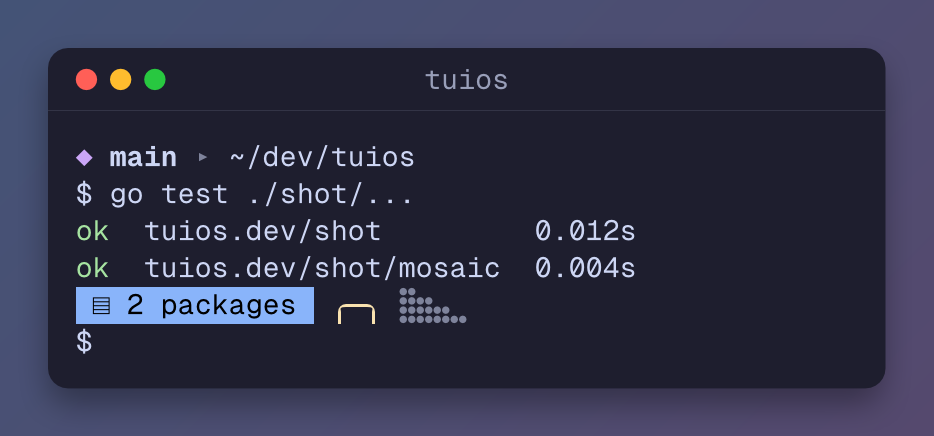
tuios.dev/shot renders a terminal screen to a picture. It takes a grid of cells and writes PNG, SVG, HTML, ANSI or plain text, with an optional window frame around it. tuios uses it for screenshots.
go get tuios.dev/shotIt needs Go 1.25 or later. It is pure Go and needs no cgo, no browser and no external tool. The API reference is on pkg.go.dev.
Use it to
- Save a picture of a screen when a terminal test fails.
- Put real terminal output in a README or in docs.
- Post the output of a command from a bot.
What it does
- PNG is drawn in Go. Box drawing, block elements, braille and powerline glyphs are drawn as shapes, so borders join up in any font.
- SVG uses real
<text>and<rect>elements. Design tools and browsers open it, and the text stays selectable. - HTML is one file with inline styles. Links stay links.
- ANSI and text write the screen back as escape sequences or as plain lines.
- mosaic, a sub-package, does the opposite: it draws a picture as cells of block glyphs.
Example
shot does not parse escape sequences. A terminal emulator does that, such as vt, and FromScreen reads its screen.
package main

import (
	"log"
	"os"

	"tuios.dev/shot"
	"tuios.dev/vt"
)

func main() {
	// A terminal emulator reads what a program printed.
	term := vt.NewEmulator(46, 6)
	defer term.Close()
	term.Write([]byte("\x1b[35m◆\x1b[0m \x1b[1mmain\x1b[0m \x1b[2m▸\x1b[0m ~/dev/tuios\r\n" +
		"$ go test ./shot/...\r\n" +
		"\x1b[32mok\x1b[0m  tuios.dev/shot         0.012s\r\n" +
		"\x1b[32mok\x1b[0m  tuios.dev/shot/mosaic  0.004s\r\n" +
		"\x1b[44;30m ▤ 2 packages \x1b[0m \x1b[33m╭─╮\x1b[0m \x1b[2m⣿⣶⣤⣀\x1b[0m\r\n$ "))

	// The palette turns the basic and indexed colours into RGB.
	p := shot.XTermPalette()
	p.FG, p.BG = shot.RGB(0xcd, 0xd6, 0xf4), shot.RGB(0x1e, 0x1e, 0x2e)
	p.ANSI[2], p.ANSI[3] = shot.RGB(0xa6, 0xe3, 0xa1), shot.RGB(0xf9, 0xe2, 0xaf)
	p.ANSI[4], p.ANSI[5] = shot.RGB(0x89, 0xb4, 0xfa), shot.RGB(0xcb, 0xa6, 0xf7)

	// FromScreen reads the screen into a grid of resolved cells.
	grid := shot.FromScreen(term, p)

	// BuildFrame dresses the grid as a window on a gradient.
	frame := shot.BuildFrame(shot.FrameSpec{
		Frame: "window", Title: "tuios", Padding: 24, Radius: 10, Shadow: true, Scale: 2,
	}, shot.FrameInputs{Palette: p})

	for _, format := range []shot.Format{shot.FormatPNG, shot.FormatSVG} {
		out, err := shot.Render(format, grid, frame)
		if err != nil {
			log.Fatal(err)
		}
		if err := os.WriteFile("screen."+format.Ext(), out, 0o644); err != nil {
			log.Fatal(err)
		}
	}
}
The picture above is this program, with GeistMono Nerd Font Mono in frame.Font and frame.BoldFont.
A program with its own screen model fills a grid directly with NewGrid. Each cell holds its text, its colours as RGB and its attributes.
Fonts
PNG looks for each glyph in this order, and the first face that has the glyph draws it:
Frame.Font, andFrame.BoldFontfor a bold cell. Without a font, Go Mono.- Each face in
Frame.Fallback, in order. - Go Mono, which shot embeds.
A glyph in no face draws as a dotted box. MissingGlyphs lists those glyphs before you render, so you can find a font for each one and add it to Frame.Fallback. Geist Mono has no ◆, ▸ or ▤. In the picture above they come from Noto Sans Mono, a fallback face.
shot parses a fallback face only when a glyph needs it, and looks up each glyph once per render. A glyph wider than its cell is centred on the cell. tuios fills the fallback list from fontconfig.
SVG and HTML name Frame.FontFamily and let the viewer pick the fonts. With Frame.EmbedFont, they also carry Frame.Font as an @font-face.
Versions
The module is at v0. The API can change between minor versions. Grid, Cell, Palette, Render, the five formats and FromScreen are settled. The fields of Frame and FrameSpec, and the mosaic package, can still change.
The pictures can change between versions. Do not compare PNG bytes in a test. Compare the grid, or the text and ANSI output.
Its tags have the folder name as a prefix, such as shot/v0.1.0. The source is in the shot folder of the tuios repository, under the MIT licence. The embedded Go Mono fonts are by Bigelow & Holmes, under the Go font licence.