Agents6 min read
Nine gaps I found by leading a crew of agents over tuios
For a day, one Claude agent ran three to five other Claude agents in tuios panes, across sessions and two machines, and kept notes on everything tuios made hard. Nine gaps came out of it, from an ask that returned nothing to mail nobody knew was read. All nine are fixed on main.
GGGaurav Gosain
tuios has a lot of commands for agents: start-agent, list-agents,
ask-agent, mail, task cards. Each one has tests, and each one works on its
own. What I had not done is use them all at once, for a whole day, the way
someone running a team of agents would.
So I did that. One Claude agent was the lead. It started three to five Claude workers in tuios panes, spread over a few sessions and one other machine, gave each a brief, read their reports, and unstuck them when they got stuck. I asked the lead to keep notes on everything tuios made harder than it should be. At the end of the day there were nine items, ranked by how much time each one cost. This post is that list, and what changed for each.
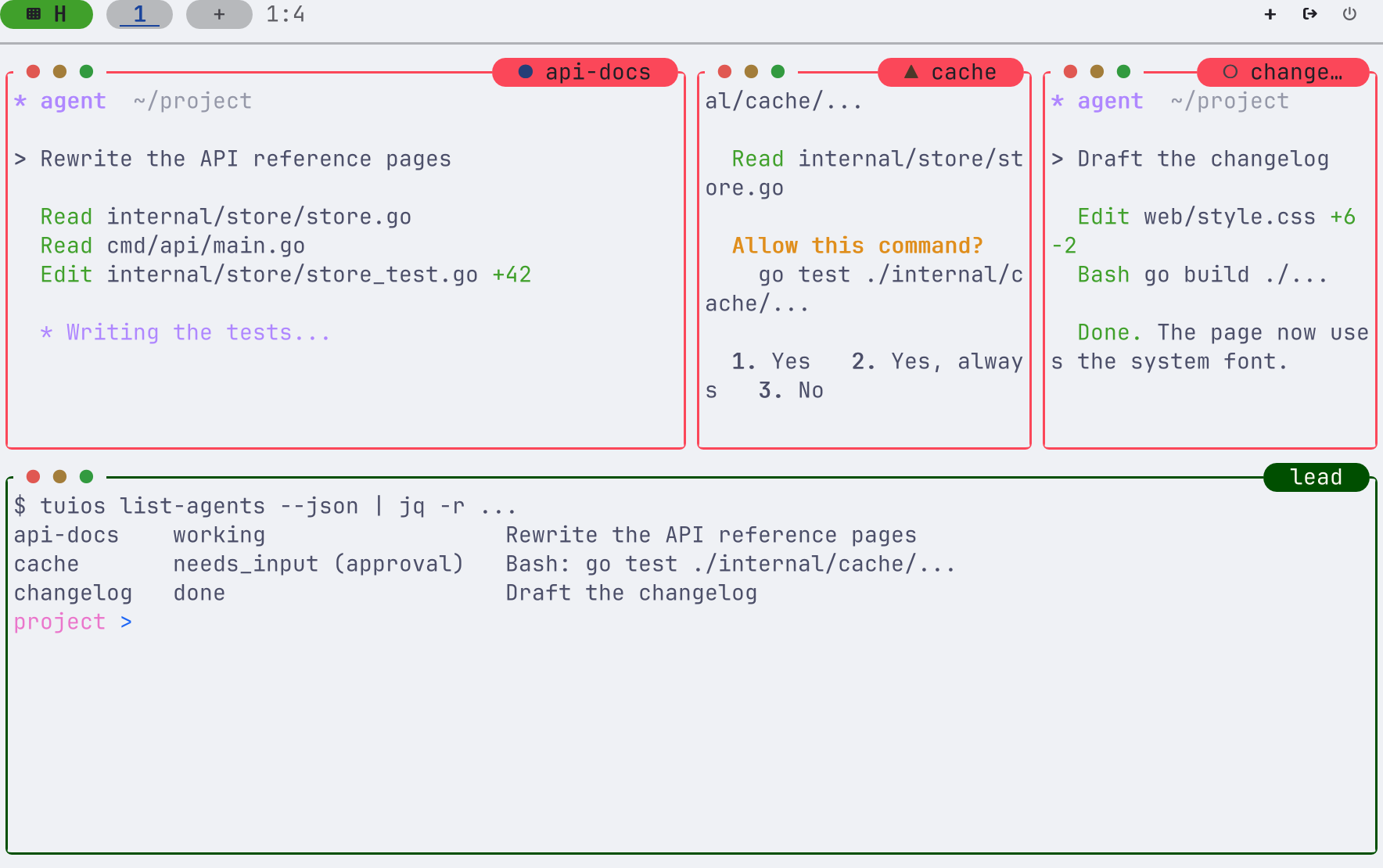
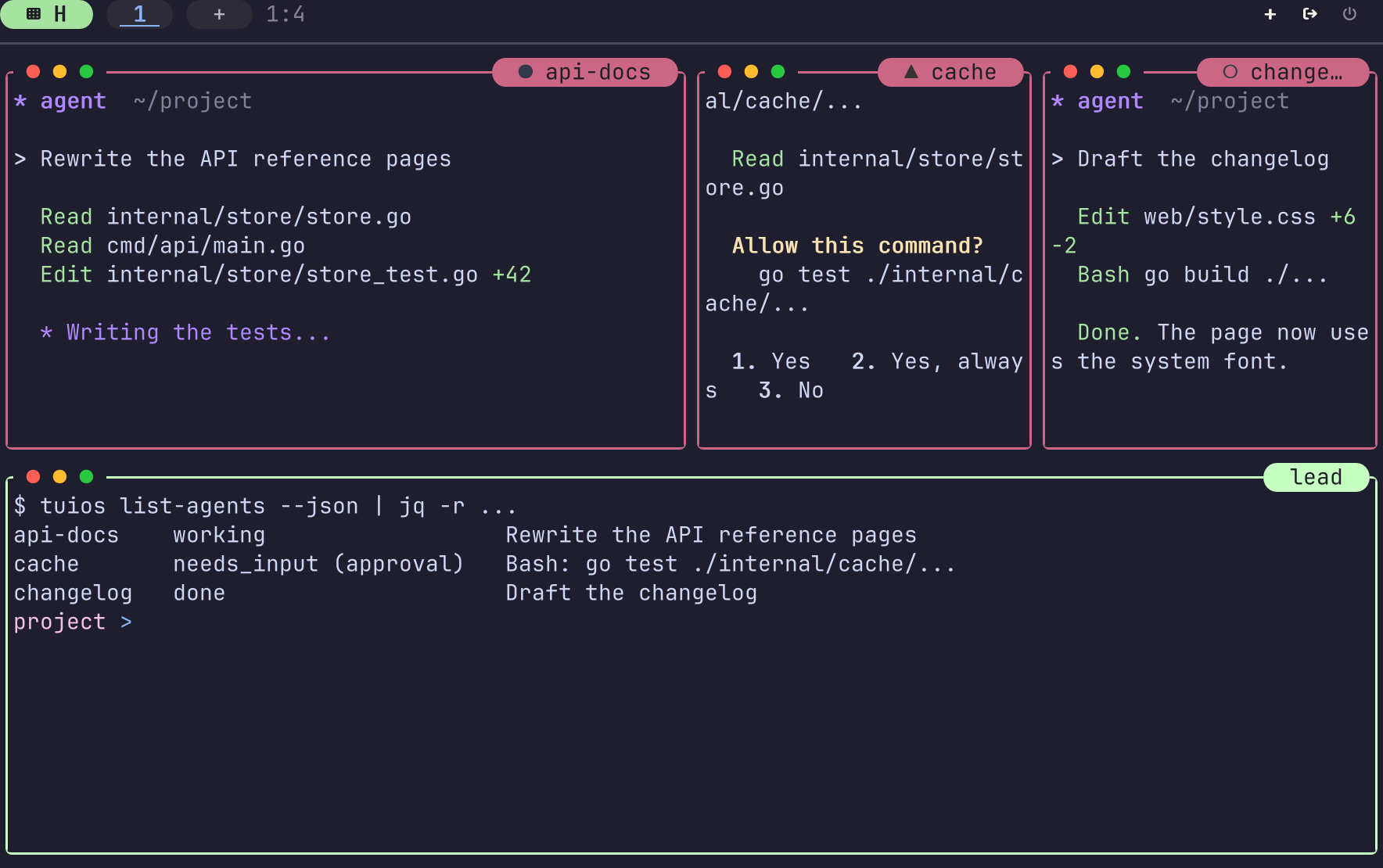
The picture is a staged crew in a scratch session, not the real one, but the
commands are the real ones: the lead reads its workers as JSON, which is what
the new lead topic of the skill teaches.
What already worked
Before the gaps, the parts that held up, because they are why the rest was worth fixing:
- Mail as the backbone. Workers mail the lead. The lead's harness hook says "You have N unread tuios messages" inside its own turn, so there is no polling and no missed report.
start-agentwaits. It types the prompt only once the agent is at its prompt.list-agentsknows the states: working, done, andneeds_inputwith the text of the approval the agent waits on.tuios cpto the other machine kept working while plain ssh was stuck on a sign-in.
The nine
1. ask-agent returned nothing from a full-screen agent
ask-agent typed the question and returned what the pane printed in between:
the text of the screen after, minus the text before. Claude Code redraws its
whole screen, so that difference can be empty. The lead asked the agent on the
other machine a question, the agent answered, and ask-agent returned an empty
reply.
Now, for a harness that keeps a transcript, the reply is the agent's own text since the question, read from the transcript. The screen difference is the fallback for agents without one. (#1801)
2. A blocking form showed as done
Claude Code sometimes asks a question of its own in a form over its input box,
such as whether to teach auto mode about the environment. No hook fires for
it. The last hook said done, so list-agents said done, and a worker sat on
that form for many minutes. Twice.
A form on screen, with numbered options and "Enter to confirm", now outranks a
stale done or idle report, and the pane reads as needs_input.
(#1803)
3. No way to run one command on another machine
To run ls or fc-list on the other machine, the lead opened a window there
with new-window --host, wrapped the command with a marker it could look for,
polled capture-pane in a loop, and closed the window. Five times in one day.
tuios run --host build -- fc-list : familytuios run --host runs the line on that machine with no pane, prints its
stdout and stderr, and exits with its status.
(#1806, and the
docs)
4. Starting a worker took 300 characters and three more steps
Every worker started the same way: a long start-agent line with its flags,
then find its id by name in a table, then type a slash command once it was
ready, then press Escape. Presets put all of that in the config:
[agents.presets.worker]
agent = "claude"
add_dirs = ["~/notes"]
grants = ["read", "write", "task"]
after_ready = ["/remote-control", "Enter", "Escape"]
tuios start-agent --preset worker --print-id starts one and prints only its
id. (#1807, and
Presets)
5. Mail sat behind a sign-in, and nobody was told
The other machine's link back to this one was waiting for a Tailscale sign-in. Its mail to the lead sat in the outbox, and neither machine said anything.
Now the outbox item says why the link is down, and its key opens the sign-in page. The other machine, when its own link is up, shows an item too: how many messages wait for it and why, with nothing of the mail itself. (#1812)
6. The skill had nothing for a lead
The tuios skill had topics for fanning out a task and for one agent working
beside you. Nothing for an agent that runs a crew. So the lead never found
list-agents --all-sessions --json or start-agent --json, and spent the day
reading box tables with grep and awk.
tuios --skill lead is that topic now: the loop with exact commands, how to
spot and unstick a blocked worker, reading across machines, cleanup, and the
rules, starting with "never answer a prompt that is the person's".
(#1802)
7. capture-pane ignored the pane you named
tuios capture-pane -s work 7e02c4a1, with the id as a plain argument, did not
read the id. It captured the session's focused pane, with no error. The lead
used that form all day, so it read the right worker only when that worker
happened to have the focus. Once it showed another agent's screen as a new
worker's.
The window is an argument now, the same as -w, and a verb refuses an argument
it does not read instead of dropping it.
(#1805)
8. Escape on a form also stopped the turn
Pressing Escape in a worker's pane to close that form from item 2 also interrupted the turn the worker was in the middle of. There was no safe way for a lead to clear a form. The skill now says to leave such a form to the person, or to use the harness's own "not now" choice by its number. (#1811)
9. A sender could not see that its mail was read
A worker's two reports still read back as queued on its side after the lead had read both and acted on them. So the worker mailed again to ask whether they had arrived. Now the sender can look:
tuios read-agent-messages --sent -w "$TUIOS_PANE_ID"#1 to review (1ce7d2a7) in work sent just now read just now
rebased onto main, please retest
#2 to docs (1342e967) in work sent just now delivered, unread
changelogThat output is from a throwaway daemon, not a mock. Each line says delivered, seen, read or undeliverable, across sessions and machines. (#1810, and Did my mail arrive)
What I take from it
None of these nine showed up in a test, because each command did what its test asked. They showed up when one agent had to use all of them together, many times, with real agents on the other end that redraw their screens and ask their own questions.
Two of them are the kind I dislike most: a command that returns something plausible and wrong. An empty reply that looks like "the agent said nothing", and a capture of the wrong pane that looks like a capture of the right one. Both now either do the right thing or refuse. The rest were missing pieces, and a day of real use found them faster than I would have by guessing.